The Sunday Letter · Sunday, October 18
A box of midges
Twelve flies smaller than a grain of rice, and why they catch more trout here than anything else.
An annotated fly-box inventory
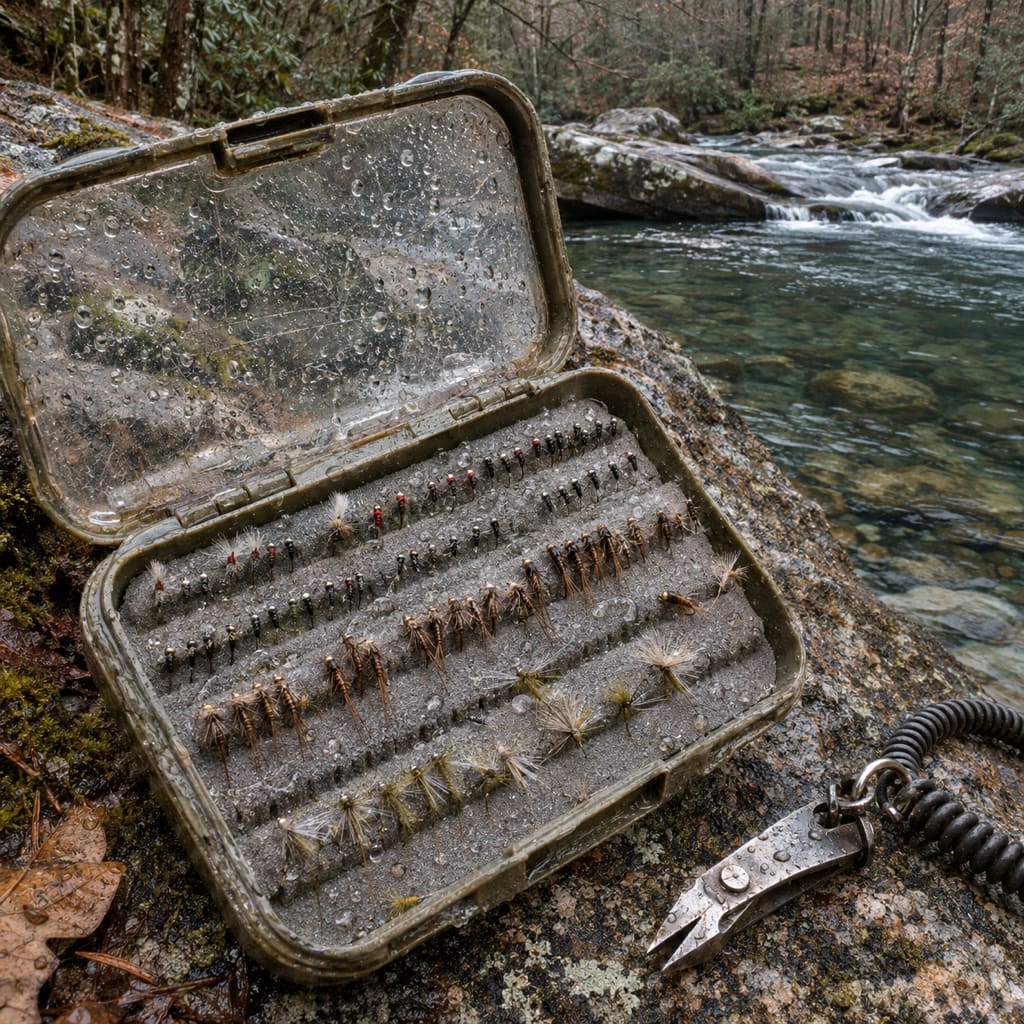
If you take one thing from this letter, take this: on the Chattahoochee below the dam, the most important insect is the one you can barely see. Midges hatch every month of the year. In winter they are often the only thing on the water. In summer, when everything else has come and gone, they are still there, in the film, in the eddies, in the trout.
A midge is a small two-winged fly with no tails. It spends most of its life as a thin larva in the gravel, rises to the surface as a pupa, hangs there for a moment just under the film, and hatches. Trout eat it at every stage, and often most readily at the moment it hangs under the surface, helpless.
My midge box looks like twelve versions of the same fly, because it is: a few fibers for a tail, a slim body ribbed with fine wire, a wisp of white for the wing, a soft collar and a bead. The differences are small, and they are the whole point. When I open the box on the river, I’m choosing a color and a weight, and the weight is a depth.
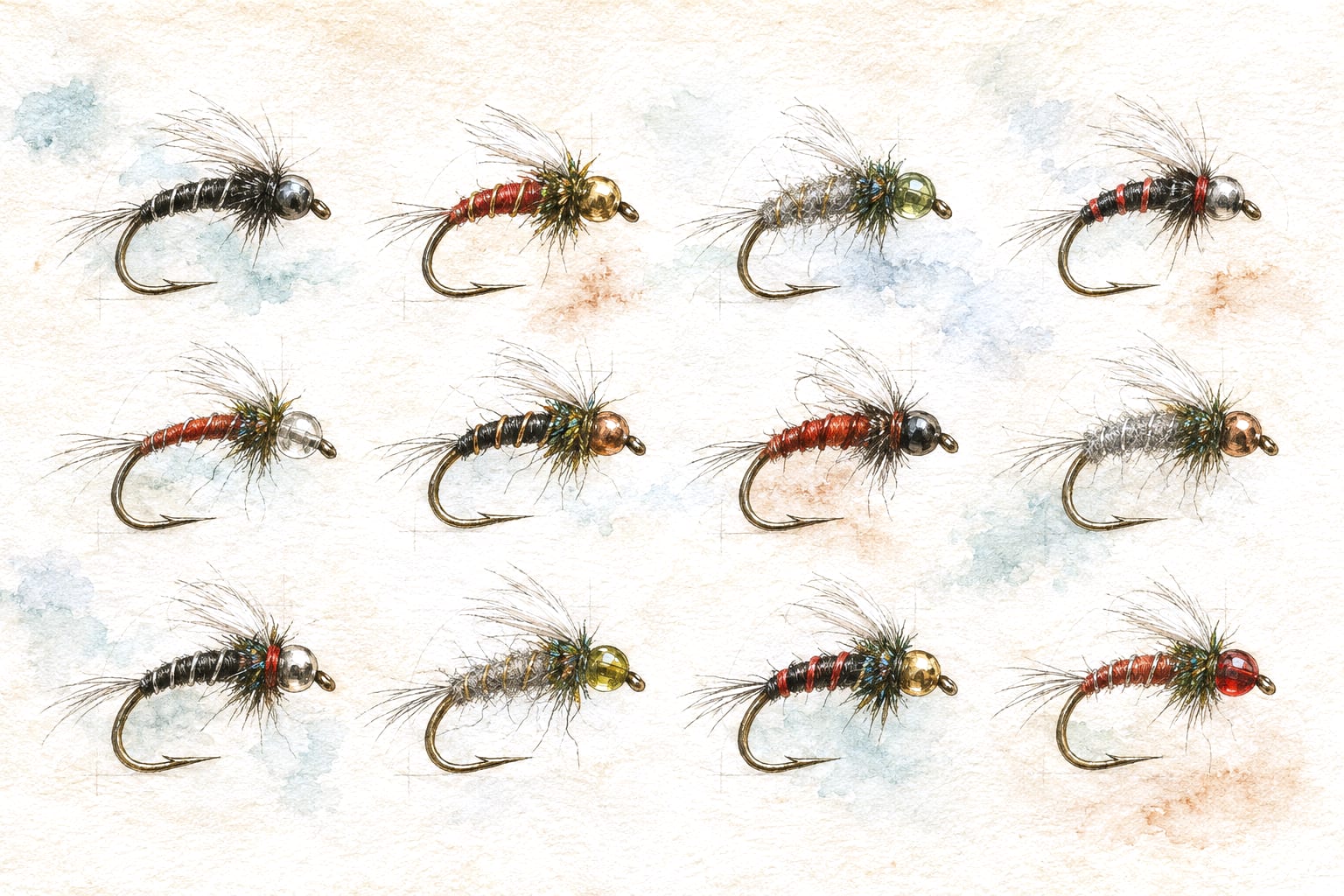
All twelve A few fibers for a tail, a slim body ribbed in fine wire, a wisp of white for the wing, a soft collar of peacock-colored dubbing, and a bead. Curved hooks, sizes 18 to 22.
Row one: where i start
- Black thread, silver wire, silver bead
- Red thread, gold wire, gold bead
- Gray dubbing, silver wire, olive glass bead
- Black thread, red wire, silver bead
Row two: bright, clear days
- Red thread, silver wire, clear glass bead
- Black thread, copper wire, copper bead
- Red thread, copper wire, black bead
- Silver-gray dubbing, silver wire, copper bead
Row three: when nothing else works
- Black thread, silver wire, a red hot spot, silver bead
- Gray dubbing, gold wire, yellow glass bead
- Black thread, red wire, gold bead
- Red thread, silver wire, red glass bead
How to choose
Before you open the box, open your eyes. Look at the eddies along the bank for tiny dark specks on the film: often adults, or empty pupal cases. Watch a rising fish several times; rings without a bubble can suggest it is taking pupae just under the film, though not always. If you see neither, start with the bottom row deep, where the larvae spend most of their lives.
In my experience size matters more than color: if a fish refuses a size 20, try a 22 before you change anything else. And use fine tippet, 6X, because in this water the trout have all day to look.
When I open the box on the river, I’m choosing a color and a weight, and the weight is a depth.
Once you can tie a zebra midge, you can tie every one of these. They are the zebra with three things added: a few fibers for a tail, a wisp of white for the wing and a soft collar of peacock-colored dubbing behind the bead; on three of them a pinch of gray dubbing takes the place of the thread body. The course’s last part starts with the zebra for exactly that reason. It is the simplest fly in the box, and it can catch fish here in any month of the year.
Small flies, fine tippet, and patience.
Ben